Richard B. Gruelle watercolor painting, spring landscape with trees

Richard B. Gruelle watercolor painting, spring landscape with trees

Jacksons Auction & Real Estate Company conducted a Works on Paper art auction in Indianapolis, Indiana on April 11, 2010. The sale featured 176 cataloged lots, with a focus on Indiana artists. A 10% buyer’s premium was charged.

The auction house, which specializes in Indiana art, drew a considerably smaller crowd than usual, with about 35 bidders on the floor. Some absentee and phone bids also came into play. Prices were strong for the top lots, which included two record auction prices. However, interest was limited among the variety of the middle-tier and lower-end works.

An 1896 spring landscape painting by Richard Buckner Gruelle (pictured above), a member of the Hoosier Group brought a record price for a Gruelle watercolor. A Wayman Adams watercolor of a New Orleans couple is also believed to have set a record price, Bryon Jackson said.

p4A.com contributing editor Don Johnson

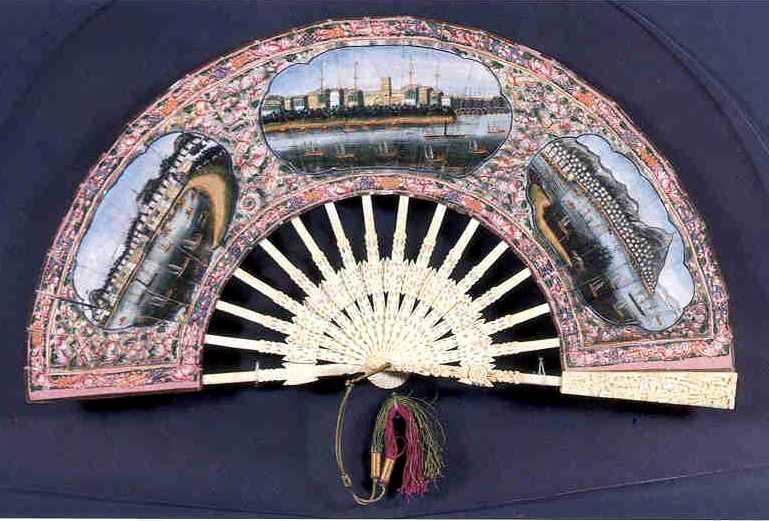
Chinese export carved ivory and painted paper fan depicting three port scenes; Macao, Canton and Hong Kong

Chinese export carved ivory and painted paper fan depicting three port scenes; Macao, Canton and Hong Kong

So much of collecting is about a sense of nostalgia, and I doubt there is anything that stirs nostalgia like a hand-held fan.  I’m sure I am not the only one who spent hot Sunday mornings in church paddling the air with a vibrantly colored cardboard picture of Jesus or had a grandmother with paper fans from the local funeral home in her glove compartment.  Sadly, with cheap electric fans and air-conditioning everywhere, hand-held fans have faded away, but not with collectors!

Collectors obviously find much to admire in early folding fans, like the elaborate painted one pictured above.   Examples carved out of tortoiseshell and ivory are also always popular, as are more unusual examples like an American needlework-on-canvas fan.  However, with the advent of affordable color printing, the fan was quickly snapped up by the advertising industry to promote everything from Frank Sinatra and Lucky Strikes to Moerlein beer and, my personal favorite, the 1893 Columbian Exposition.

-Hollie Davis, Editor, p4A.com

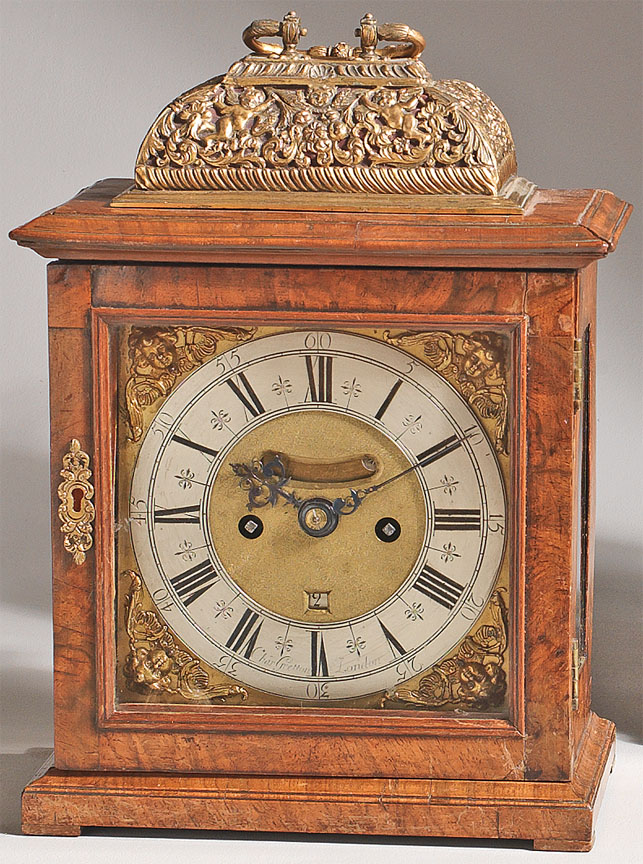
Charles Gretton English bracket clock

Charles Gretton English bracket clock

Time is an amazing and strange thing, and there are endless philosophical discussions on how time, the ability to measure it, and the ways we track it have affected both the development of civilization and the pattern of our daily lives.  Horology, the name given to the study of measuring time, encompasses everything from sundials and water clocks to mantel clocks and digital watches.

One of the things that makes building a horological collection so fascinating to those who do it (and so alien to those who don’t) is the consideration of both the external and the internal.  With many antiques, the issues are largely about the exterior and, in some cases, construction of a single object, but with clocks and watches, there are really not just two separate facets, but truly two separate objects to consider: the case or exterior and the works.  This makes clocks a blending of art and science, because while art dictates the aesthetics and value of the case, much more esoteric construction and mechanics determine the value of the movement.  You can’t, without a fair amount of study and knowledge, look at a movement and assess a value.  As a result, quite frequently at auction, we’ll see a terrific case with a mediocre – or worse – movement bring a respectable price.  (This is a great paint-decorated case, but movements like the one here appear in large numbers and are normally considered very average.)  Less frequently, we’ll see a dull or damaged case with a great movement bring a respectable price, or even a great price, as is the case with the bracket clock pictured above that had a rare, desirable movement in a case considered to be an ill match.  What we all watch for are the combinations of great case and great movement – you may not know what you’re looking at when you see the clock, but you’ll certainly know when you see the final price!

Earlier this month, Skinner, Inc., an auction firm in Massachusetts held an incredible sale, primarily filled with material from the collection and the library of one collector.  It was the sale of a true collection, filled not just with objects (an incredible array of watchmaking bench tools like hand tools and wheel-cutting machines, necessary to create the tiny cogs used), but also with classic works from the accompanying library on the history of time, clockmaking and mechanics.  The reference books are one of my favorite things that we often see among such collections – fascinating to scholars because they reveal, often with clear illustrations of the objects, the range of items available.  Sometimes we even see period catalogues that list the actual cost of items.  All these things are often difficult to dig up through the traditional tools – census records, deeds, and wills – that are available to material culture scholars.  Building such an incredible collection takes time, but with horology, you certainly have plenty of that!

-Hollie Davis, Editor, p4A.com

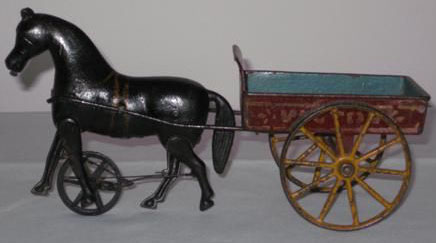
Ives cast iron walking horse drawn "Victory" cart, circa 1890

Ives cast iron walking horse drawn "Victory" cart, circa 1890, sold for $1,237 at Davies Auctions

Davies Auctions held a multi-owner sale on Feb. 27, 2010 at Judi’s Catering Banquet Hall in Lafayette, Indiana. The merchandise consisted of cast-iron and tin windup toys from two collections (including the longtime collection of John Lippman), a variety of vintage Christmas collectibles, and a selection of antiques, primarily country and Americana smalls. Only a few pieces of furniture were offered.

Snow and freezing drizzle in Indiana the night before the sale made the roads slick, but the weather didn’t appear to keep away bidders. A standing-room-only crowd was supplemented by a fair number of phone and absentee bids. Ninety-two lots of toys were cataloged. There were numerous uncataloged lots. The auction was promoted on Davies’ Web site, as well as AuctionZip, but there was no Internet bidding.

“I thought it did just fine,” auctioneer Doug Davies said of the sale. “There were probably a few soft spots.” In specific, he said prices for holiday items were down a little, and that the Baird advertising clock might have done better. However, the toys did well, with bids from as far away as Pennsylvania and Florida, while one floor bidder was from Kansas. The Alfred Montgomery painting also saw strong interest and did well for its size.

Successful bidders paid a 10 percent buyer’s premium.

-Don Johnson, Editor, p4A.com

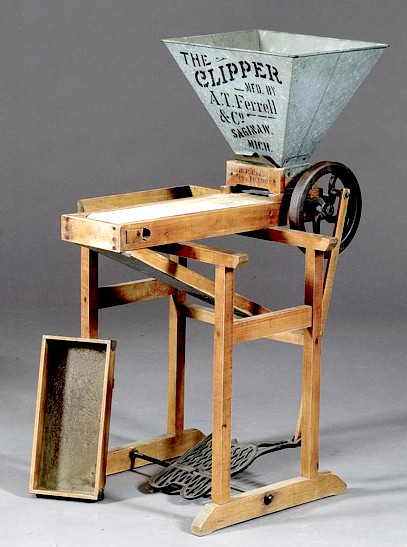
A.T. Ferrell treadle-powered Clipper Seed and Grain Cleaner

A.T. Ferrell treadle-powered Clipper Seed and Grain Cleaner

If you grew up on a farm, spring probably makes you homesick with nostalgia.  (Not to worry – one really hot day in July will cure you!)  Nostalgia may be part of what is fueling the popularity of farm-related objects at auction.  And the best part about collecting farm equipment is that you get all of gadgets and none of the work!

Of course, some of the biggest prices in the farm equipment arena are commanded by antique tractors, like a 1913 Case Model 30-60 that brought over $400,000 at auction, and the folk-art appeal of figural animal windmill weights makes them popular (my favorite is the squirrel).  There are still nifty tools to be had at affordable prices, though, like hand-cranked corn shellers or the treadle-powered seed and grain cleaner pictured here.  It’s enough to make you feel like heading out to plow the back forty, and we’ve even got a plow or two to choose from!

-Hollie Davis, Senior Editor, p4A.com

« Older entries § Newer entries »