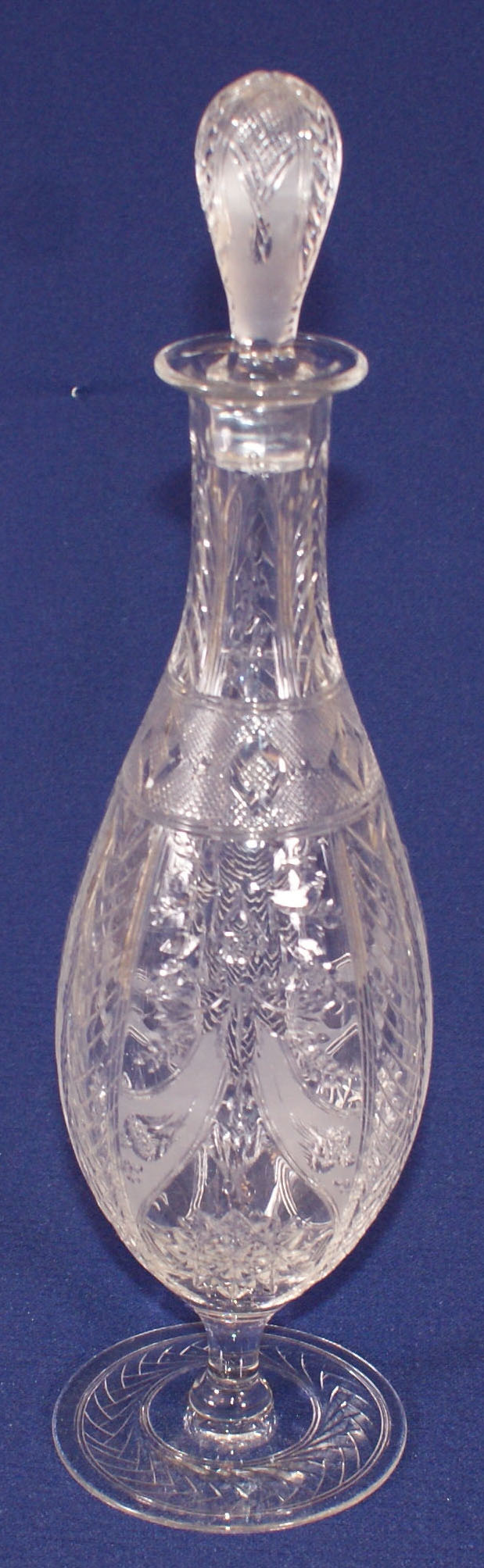
Heisey clear glass 4036 Marshall footed decanter

Heisey clear glass 4036 Marshall footed decanter

One of the things I love about 19th-century history are all the “rags to riches” stories.  In an age when it’s so hard to get ahead, when opportunities often seem predicated on education, financial resources, or nepotism, I enjoy hearing a good story about someone who gets ahead through intellect, intuition and hard work and one generally doesn’t need to look further than the industrial boom of the 1800s to find fascinating character studies.

Augustus Heisey was such an individual.  Born in Germany in 1842, he immigrated to Pennsylvania with his family in 1843, but when his father died, his mother left him with an older sister and returned to Europe.  At 19, Heisey took a position as a clerk at a Pittsburgh glass company, where he began to learn about the glass business.  After serving in the Civil War, he returned to the glass business, soon moving into a sales position with the Ripley Glass Company where he married the daughter of one of the owners.  (Okay, so nepotism’s nothing new….)  Through hard work and some luck, by the turn of the century, Heisey had started his own company in Newark, Ohio where three furnaces and 700 people where busy cranking out affordable pressed glass.

Heisey glass still brings people to Newark today for the annual Heisey Collectors of America convention in June.  The convention is held at the Heisey Glass Museum and a local auction house has a special sale of Heisey glass to capitalize on the visiting collectors.  While Heisey was known for pressed glass so well executed that it appeared to be cut glass, the bulk of their production was stemware or other pieces for table service, like pitchers, creamers and sugar bowls, often made to fill large orders from hotels and bars.  Today, much of this material doesn’t fetch a great deal at auction, but some of the specialty pieces that come up for sale each June are amazing and can bring thousands of dollars.  Colored glass, which wasn’t produced by Heisey in great quantities until the 1920s and 30s, is the most popular with collectors, and with examples like these dolphin candlesticks in amber, who can argue?  Still, the beautiful clear glass decanter pictured above brought more than $3,000 at auction, so even less colorful examples can be the beginning to someone else’s rags-to-riches story!

-Hollie Davis, Senior Editor, p4A.com

Click here to browse all Heisey glass in the Prices4Antiques database.

Reference & Further Recommended Reading:


To search the Prices4Antiques antiques reference database for valuation information on hundreds of thousands of antiques and fine art visit our homepage www.prices4antiques.com


Zoar, Ohio handmade child's chest of drawers

Zoar, Ohio handmade child's chest of drawers

This Zoar, Ohio handmade child’s chest of drawers was sold at a recent auction. What makes this chest so unique is the extreme documentation it carries, including pencil inscribed drawers with figural drawings and one of a military camp plus personal inscriptions. The chest is signed on the top right drawer, “Made at Zoar Furniture Trust Co Warren County Ohio in 1900 by J. Emerson”. Although the date of 1900 is late, this piece gives us the full who, what, where, when and why of its history.  It even tells us that the builder was a proud member of Co E, 23 KY, USA and shows him on picket duty. Civil War?

Inscription on the side of one of the drawers: "Made at Zoar Furniture Trust Co Warren County Ohio in 1900 by J. Emerson."

Inscription on the side of one of the drawers: "Made at Zoar Furniture Trust Co Warren County Ohio in 1900 by J. Emerson."

Note: The origin of this chest is not to be confused with the German Separatist commune located at the town of Zoar in Tuscarawas County, Ohio. In Warren County, Zoar is an unincorporated place in northern Hamilton Township between Hopkinsville and Morrow and south of South Lebanon in the Virginia Military District survey 1546. This Zoar community was one of the earliest settlements in this area, having been founded before 1847.

View the auction record for this chest at Prices4Antiques.com. Sign-in or subscribe for sales history.

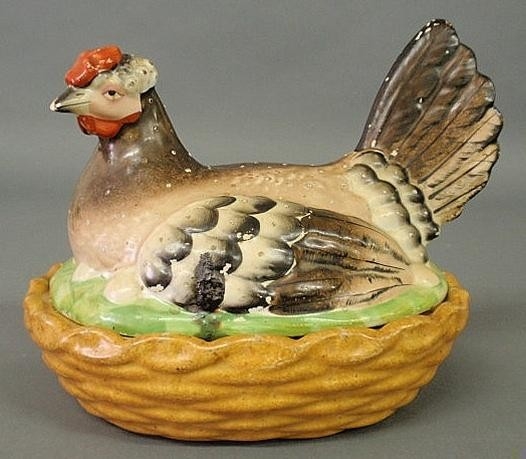
Staffordshire porcelain figure hen-on-nest dish

Staffordshire porcelain figure hen-on-nest dish

Some of the most ubiquitous antiques are hen-on-nest covered dishes.  They’re so common that they’ve acquired a sort of shorthand in the antiques business or become somewhat of a joke, but in reality, they’ve got an interesting history.  While people may not realize it, the form – a laying hen cozy in her nest – originated in China several centuries ago and found popularity in Europe in the late 18th century.  According to some historians, they were originally used, depending on their size, to serve boiled or scrambled eggs or butter.

Of course, with Europe setting the fashions at the time, hens on nests gained popularity in the United States as well.  Exported by places like Staffordshire (where the classic example pictured above was created), they remained fairly expensive until the middle of the 19th century when the technique of pressing glass was developed.  Pressed glass made producing hens on nests much more affordable, and this, coupled with the Victorians’ love of animal forms and figures, made them boom in popularity.  They began to appear in all different shades of glass and with a variety of finishes.   (Hens on nests were such a popular motif that they also appear in candy molds, cast-iron banks, and marble sulphides.)  Then around the turn of the century, manufacturers began to cash in on the popularity of the form, packaging condiments like mustard in hen-on-nest dishes to sell.  This resulted in examples from many major American glass manufacturers at the time, companies like Fenton and Greentown.  Today, collectors can chose hens on nests in carnival glass or milk glass, majolica or Staffordshire, and while the prices they bring won’t always feather your nest, they can certainly make it more colorful!

-Hollie Davis, Senior Editor, p4A.com

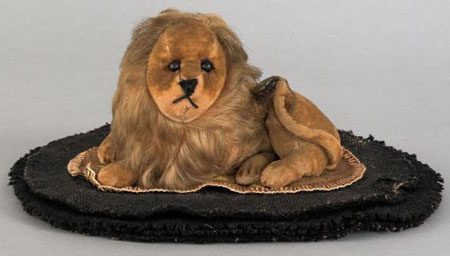
Felt pen wipe with a recumbent lion

Felt pen wipe with a recumbent lion

More than 50 felt pen wipes, the collection of Edwa F. Wise, recently sold at Pook & Pook in Downington, PA.  Pen wipes, which are rarely seen at auction, come in a variety of whimsical forms and date to the days before modern ball point and felt tip pens when people wrote with nib or dip pens.  These pens, having no ink reservoir, were dipped into an inkwell to collect ink, and a pen wipe was necessary to wipe any excess ink from the nib, or tip of the pen.

Pen wipes were sometimes in the form of bronze figures with bristled backs, while others, like those in the Wise Collection, were handcrafted out of felt.  They were often made as small gifts and exhibit a great deal of skill and creativity. The creative forms they were made into, usually animals, are endless and include examples like a puppy drinking water, prize pigs, and mice nibbling on pretzels and cornHuman figures also exist, as well as the more commonly seen heart-in-hand design, and they are found in both two- and three-dimensional forms.

-Jennifer Castle, Editor, p4A.com

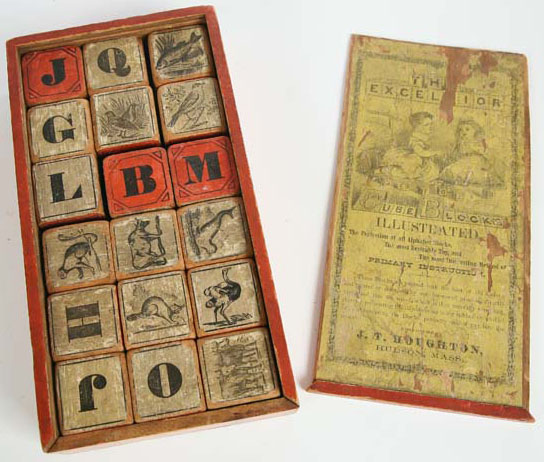
J.T. Houghton Excelsior Illustrated Alphabet Cube Blocks

J.T. Houghton Excelsior Illustrated Alphabet Cube Blocks

When did toys become so complex?  Until about eight, my life was complete with a Raggedy Ann doll, my trusty rumbling Big Wheel, a checkerboard, a mismatched set of Legos, a tub of crayon stubs and a heap of recycled scrap paper.  And access to the garage….  Honestly, when I think of the amount of trouble I was able to get into with a limited supply list, I realize that my brother and I were sort of the MacGyvers of childhood mischief.  And yet today, I’m facing down an industry that wants me to believe that from birth, a child requires a constant battery-fed diet of bouncing, flashing, chiming, beeping and buzzing!

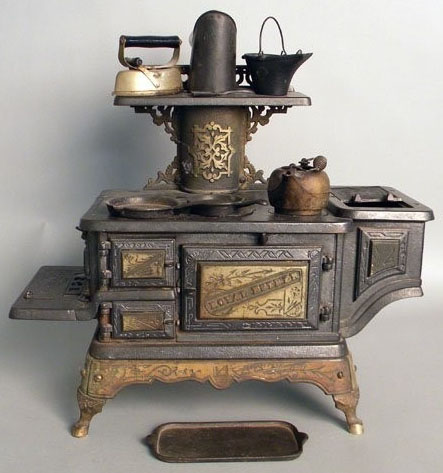
Cast iron Royal Esther toy stove by the Mt. Penn Stove Works

Cast iron Royal Esther toy stove by the Mt. Penn Stove Works

Clearly, there are collectors who agree with me, choosing to treasure the nostalgic relics of their childhood.  Toys that were popular years ago are still popular with collectors today.  Simple toys like miniature stoves (without lights and working knobs), wood blocks (like the ones pictured above, without interlocking tabs designed by MIT engineers), and barnyards full of animals (that do not make noises and are not fully-articulated) often bring great prices at auction.  As is the case with many items, rarity contributes to value, and most children’s toys and board games are rare simply because they don’t survive being “loved” for years, meaning that moms tend to toss them when cleaning out closets.  It’s important to keep in mind that because rarity affects prices, some of the most common toys and games like Monopoly actually don’t always bring large sums.  Unusual games that few people have heard of, like Going to the Klondike and The Stanley Africa Game, tend to bring stronger prices, especially if they’re from the early days of board and parlor games in the late 1800s.  All of this leads to a second value factor buyers should keep in mind: condition, as game pieces end up missing, boxes cave in and paint wears off over time.  We often hear about toys in original boxes bringing great money, and that’s probably in part just because retaining the box is a convenient shorthand way of conveying that the toy has been well-cared for over the years.

With vintage toys commanding strong prices, it pays to double-check when you’re cleaning out closets or sorting through a picnic table full of things at a yard sale.  Just make sure you count all the pieces to guarantee that you’re not “Sorry!” about your purchase!

-Hollie Davis, Senior Editor, p4A.com

Click here to browse all toys in the p4A database.

« Older entries § Newer entries »