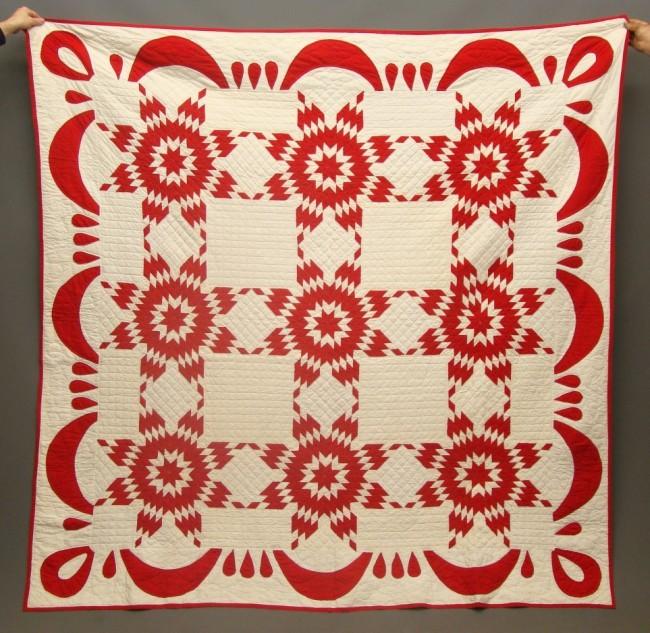
A 19th century American pieced and appliqued quilt, red and white Touching Stars

A 19th century American pieced and appliqued quilt, red and white Touching Stars

Handmade Heirlooms Can Last for Generations; Tips for the preservation and care of beautiful and fragile handcrafted works of the quilt makers’ art.

History in Fabric

Quilts are like a fabric scrapbook of family history handed down from generation to generation.  With the proper care and storage, these beautiful hand-worked heirlooms can last for years.

Quilt Analysis

To determine the proper care and storage regimen for your quilt, first make a thorough examination of the quilt.  Note any spots or stains. These should be dealt with before storing, as even the tiniest food stain will attract hungry insects.  Inspection should include determining the fabric content of the quilt top, backing, and applied decorations.  Crazy quilts, in particular, are apt to contain wool and wool fibers.  Check for damaged or missing stitches, which should be repaired by an expert before storing.

Quilts & Lighting

All fabrics, and especially quilts, must be kept out of direct sunlight, which can not only fade colors (blue is particularly prone to fading), but weaken the fibers and cause deterioration.  Not only should quilts be out of the sun, direct fluorescent light can be harmful as well.  Quilts are most safely stored in low-light or even dark areas and out of the path of reflected light.

Quilts & Climate Control

Quilts do best in a constant temperature of between 55 to 65 degrees, which means they need to be kept out of the basement and attic as well as your married daughter’s childhood bedroom that you never use because it’s too hot in the summer.  It’s also important to control humidity, which should be a constant 50 percent.  High humidity causes mold and mildew that stain fabric.  Humidity that is too low causes dry rot.

Quilts & Pests

Your quilts make a cozy haven for mice, squirrels and other small mammals, so it is important that the area be secured against such invasions and inspected with some frequency.  Insect pests prefer dark and undisturbed locations such as the back of a closet in an infrequently used room.  Check for signs of insect life before storing your quilts.  Moth crystals are effective, but should never come in direct contact with the quilt as long term exposure to chemicals can damage the fibers.

How to Clean Your Quilts

Quilts of recent vintage and high cotton content can be cleaned in a washing machine.  Inspect the quilt carefully fist, making sure there are no tears, broken stitches, or shredded areas which will all be made worse from machine washing.  Use a large or commercial washer on its most delicate cycle for its shortest duration along with a small amount of a mild (formulated for babies) detergent.  Wash in cold water, and rinse until the rinse water is clear enough to drink.

You can air dry your quilt outside. Place the quilt on your lawn atop a clean white sheet.  Put another sheet on top to prevent stains from blowing grass and leaves, family pets, wildlife, and passing birds.  Sturdy, recent vintage quilts can be dried in the sun when covered with a sheet, but avoid direct, mid-day, midsummer sun.

If a quilt is older consider vacuuming it if you have a vacuum with gentle suction.  Vacuum your quilt through a fiberglass screen (available at hardware stores) making sure that the rough edges of the screening material do not tear the quilt.  If your quilt is very old, very delicate, very precious, or very valuable, check with a Conservator or other expert before using any cleaning method.

How to Store Your Quilts

Quilts are best stored flat and unstacked.  If you don’t have the space, they can be rolled and folded with the following precautions. If you’re storing them in a cedar or blanket chest, avoid contact with the wood.  Quilts should be carefully wrapped in acid free tissue, white cotton sheets, or washed, unbleached muslin.  Roll or fold your quilts in the aforementioned materials carefully padding any folds with extra tissue or fabric.  Never store your quilts in plastic bags or storage bins, and be certain to refold them periodically or the fibers will weaken along the fold lines.

-Article by p4A contributing editor Susan Cramer.
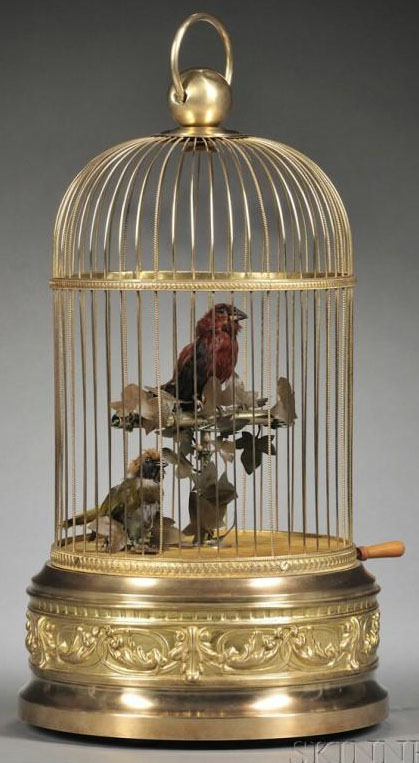
The following item was recently sold at an American auction house. Detailed information about this item, including pre-sale estimate, price realized and sale location can be found in the Prices4Antiques reference database.

Double singing bird automaton by Bontems, France, no. 5414125

Double singing bird automaton by Bontems, France, no. 5414125

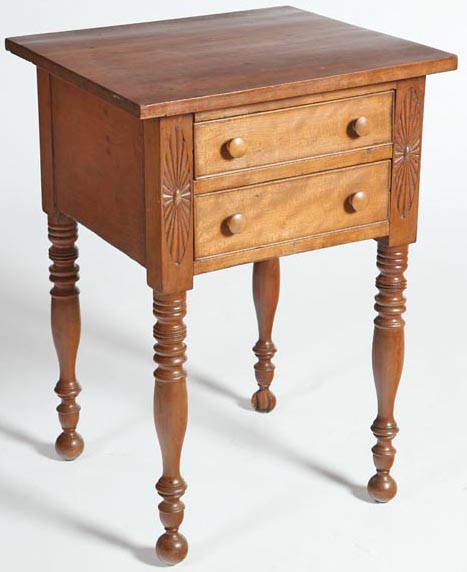
Sheraton two-drawer stand, probably from Fairfield County, Ohio, 1820 to 1840

Sheraton two-drawer stand, probably from Fairfield County, Ohio, 1820 to 1840

The iconic images of the Midwest – the ever-moving pioneer, the isolated communities, the Mississippi River and all its tributaries – are the exact things that make Midwestern decorative arts such a challenge to study!  With people always on the move and goods shifting up and down river communities and influencing tastes, finding enough “diagnostic features” to create an identified pool of objects and to make firm attributions is a challenge in many areas.  These factors make the research being done in Fairfield County, Ohio all the more fascinating and important, because the findings there illuminate not only Lancaster, Ohio and the surrounding countryside, but also help shed a little light on many of the long-held ideas about the American Midwest.

On the Fairfield County, Ohio Decorative Arts website (http://www.fairfielddecarts.com), Deward Watts, a local independent researcher and collector, is piecing together his accumulated knowledge from years of ferreting out objects, tracking down genealogy, and sorting out local history.  Focused on the craftsmen and artisans of the area and the objects they created prior to 1850, the site is organized into six categories: clock makers, furniture makers, gunsmiths, silversmiths, and weavers.  Watts acknowledges that the lists are undoubtedly incomplete, but they include all those he’s uncovered in more than a decade of research and, whenever possible, objects from the makers are shown with the details of their personal histories that have been gleaned from newspapers and public records.  What the site hopes to do is draw attention to the region’s decorative arts, to create a database of objects attributed to the region, and to hopefully allow others to use the resource to identify other Fairfield County objects.

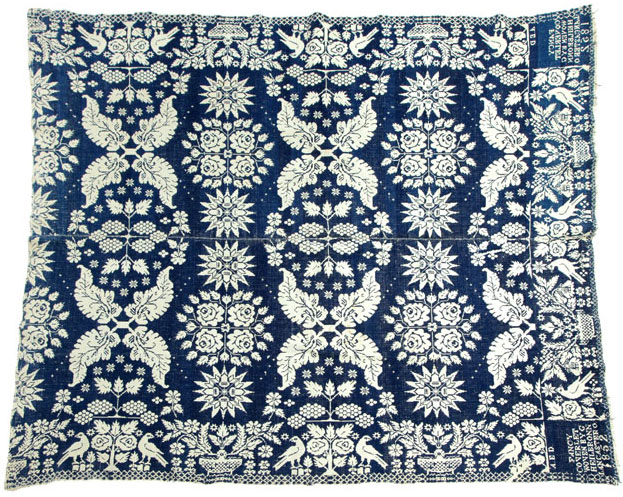
Ohio jacquard coverlet. George Heilbronn, Lancaster, Fairfield County, 1852

Ohio jacquard coverlet. George Heilbronn, Lancaster, Fairfield County, 1852

The Prices4Antiques database includes a number of examples of the objects attributed to Fairfield County, Ohio, and quite likely, an even greater number of objects from Fairfield County for which no attribution has yet been made.  And, through our sponsorship of the Midwest Antiques Forum, this sort of focused, independent research is exactly what we hope to encourage.  Much of the area of Midwestern decorative arts remains a puzzle, but the work Watts and others are so passionately devoted to doing is certainly helping to put more pieces on the table!

-Hollie Davis, Senior Editor, p4A.com

Nembhard N. Culin poster for the 1939 New York World's Fair

Nembhard N. Culin poster for the 1939 New York World's Fair

Building the World of Tomorrow at the New York Fair – A History of  New York’s 1939 Fair, the Trylon & Perisphere, and the astonishing array of  World’s Fair collectibles

War in Europe and the Depression at home didn’t stop New York city fathers from hosting their first full scale World’s Fair. Many saw it as a way to generate income through tourism as with Chicago’s 1933-34 Century of Progress.  The N.Y. Fair, while not a commercial success generated the iconic Trylon & Perisphere and hundreds if not thousands of collectible souvenirs.

1939-40 N.Y. World’s Fair History

In 1935, New York’s city leaders began talking about the possibility of a New York fair for 1939.  This year was an appropriate choice, as it was the 150th anniversary of the inauguration of George Washington at Federal Hall in New York City.  Some leaned towards a historically oriented fair, but ultimately, using Chicago’s Century of Progress as a model, the ’39 fair was themed “Building the World of Tomorrow.”   The design board included  visionaries of modernism  Norman Bel Geddes, Raymond Loewy, Henry Dreyfuss, and Walter Dorwin Teague.  The architecture of the fair continued the use of the streamlined art deco forms that had dominated the Chicago fair five years earlier.

New York Fair in Flushing Meadows

Robert Moses, the commissioner of city parks, sold the board on his choice of site.  Flushing Meadows, 1,216 acres of marshy wasteland the city used as a dump, was referred to in F. Scott Fitzgerald’s The Great Gatsby as “. . . as valley of ashes. . bound on one side by a small, foul river.”  Moses hoped that the reclaimed land would become the future home of Flushing Meadows Park when the fair was over. Unfortunately for the New York, the 45 million attendees spent considerably less than the $67 million the fair had cost.

Trylon & Perisphere and International Exhibits

The Trylon, a 610 foot tower, and the 180 foot diameter Perisphere became the signature structures of the fair, and may be the most recognizable of all World’s Fair icons.  The empty Trylon was connected via a spiral walkway called the Helicline to the Perisphere, which housed an exhibit called Democracity.

Considering the state of affairs in Europe, a surprisingly large number of nations participated in the 1939 fair. A total of 60 countries and international organizations had a presence in Flushing Meadows.  Conspicuous by its absence was Germany-Adolf Hitler had been offended by detrimental comments made by the Mayor of New York, and was saving his time and money for less wholesome endeavors, as the world would soon see.

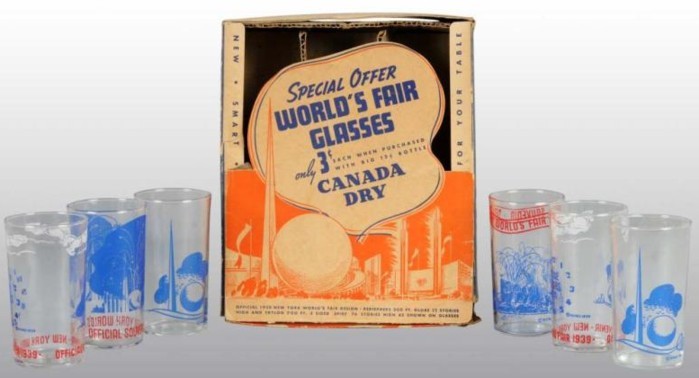
Set of 1939 New York World's Fair Canada Dry soda glasses in the original box

Set of 1939 New York World's Fair Canada Dry soda glasses in the original box

1939-1940 World’s Fair Souvenirs

World’s Fairs were tourist destinations, and as such, today’s collectors can choose from a broad range of destination type souvenirs as well as brochures, train schedules, and memorabilia having to do with daily operations of the fair.

For the New York World’s Fair of 1939-1940, souvenirs included ashtrays, coasters, place mats, snow globes, pillow covers, teapots, vases, soda glasses, plates, silver spoons, trays, jigsaw puzzles, salt & peppers, pen knives, thermometers, jewelry boxes, dolls, compacts, match safes, tumblers, tea cups, letter openers, tie clips, and more.  Manufacturers offered their own commemoratives as well, among them Heinz who distributed pickle pins, Planter’s Peanuts producing pin back buttons and special tins, and Kodak offering a special edition camera.  A large majority of these give-aways feature the likeness of the Trylon and Perisphere such as this still bank.

Today’s Prices for 1939-40 World’s Fair Collectibles

Prices are reasonable for almost every kind of fair collectible.  Postcards range from $1-2 each.  A set of five plastic coasters might cost $15-20, and teapots sell for anywhere between $50-80.  A snow globe recently sold on eBay for $58, and a Trylon & Perisphere thermometer in Bakelite brought $35.

-Article by p4A contributing editor Susan Cramer.
Reference & Further Recommended Reading:


To search the Prices4Antiques antiques reference database for valuation information on hundreds of thousands of antiques and fine art visit our homepage www.prices4antiques.com


The following item was recently sold at an American auction house. Detailed information about this item, including pre-sale estimate, price realized and sale location can be found in the Prices4Antiques reference database.

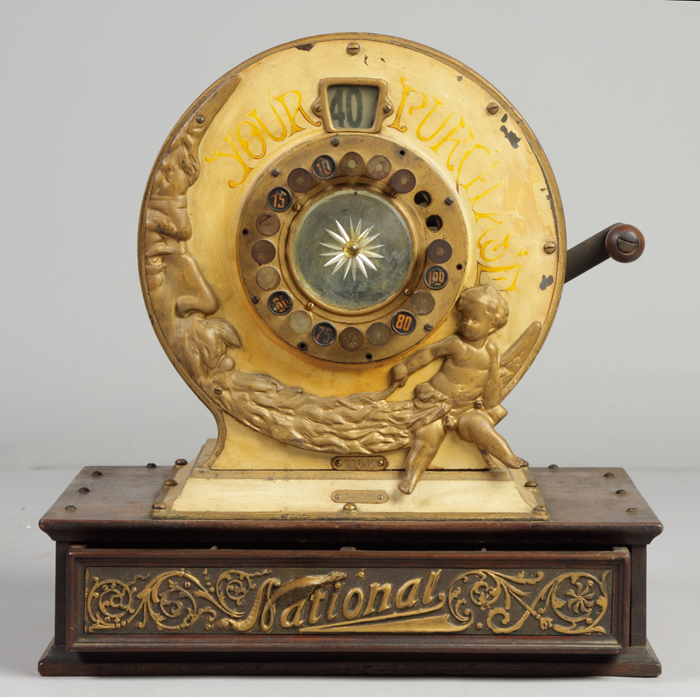
National Cash Register, dial model, dated 10-3-1894.

National Cash Register, dial model on base, Dayton, Ohio, dated 10-3-1894.

National Cash Register, dial model on base, Dayton, Ohio, dated 10-3-1894.

« Older entries § Newer entries »